
Calm Down! Why Recent Tech Outages Will Persist: Insight on AI Exposes the Thin Margin of Our Digital Reliability
Key Takeaways
- The recent wave of tech outages (FAA groundings, Microsoft cloud blackouts, JPMorgan Chase banking stalls, NSA network problems) is driven mainly by routine patches and updates hitting fragile, aging open-source code, not by sabotage or rogue AI.
- Open-source components make up 98% of commercial codebases, and 93% contain unmaintained components.
- AI now finds software flaws and builds working exploits faster than people can fix them, shrinking the time to exploit from months to days or hours.
- Pulitzer Prize-winning journalist Byron V. Acohido expects this instability to persist for 18 to 24 months.
- People run on the same thin margin of reliability, which is why the human layer of security (the “Wetware”) needs as much attention as the code.
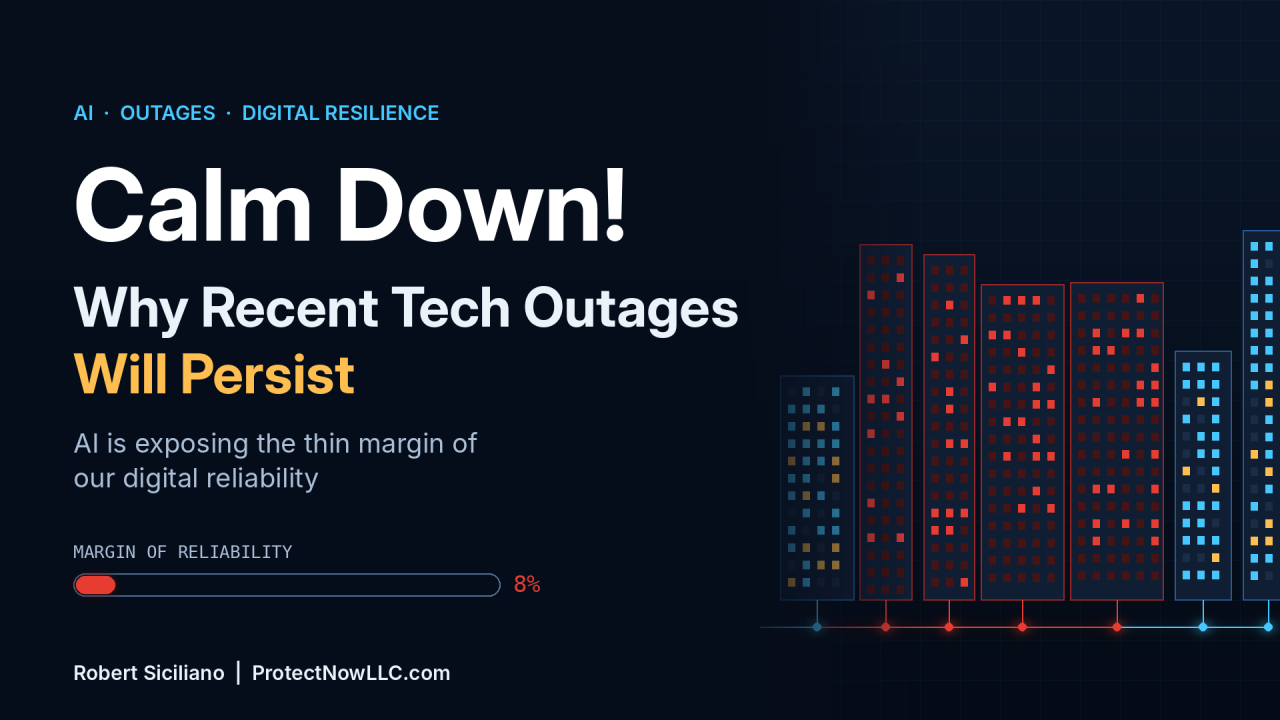
As digital infrastructure faces unprecedented strain, modern commentary is flooded with influencer and pundit alarmist nonsense narratives. Yet, in his profound analysis, Pulitzer Prize-winning business journalist Byron V. Acohido cuts through the noise. In his pivotal article, My Take: Conspiracy theories miss the real story — AI is exposing our thin margin of reliability, Acohido argues that sweeping panic over outages and cyber threats misses a much deeper systemic vulnerability. Acohido points out that instead of malicious geopolitical plots or rogue systems, “our digital infrastructure is running out of its margin of reliability, the cushion that lets a system absorb a bad update or a sudden surge”.
The Reality Behind the Panic
Recent widespread technological disruptions—ranging from FAA groundings and Microsoft cloud blackouts to banking stalls at JPMorgan Chase and NSA network degradations—have sparked a wave of public panic and conspiracy theories. When major systems falter, commentators frequently lean toward sensationalism. Acohido observes how these narratives take root because “when the people who run critical systems don’t explain what’s happening, quickly and plainly, someone else will”.
The true driver behind these incidents is not malicious geopolitical sabotage or rogue artificial intelligence, but routine fixes, updates, and maintenance applied to fragile, aging open-source codebases. Our core digital infrastructure has exhausted its structural cushion required to absorb unexpected surges or routine patches.
Acohido notes that open-source code, which began as an act of idealistic community collaboration, now underpins 98% of commercial codebases, leaving modern enterprises operating on “one volunteer’s weekend job” and legacy infrastructure. Acohido emphasizes that artificial intelligence is now accelerating this exposure: “Now the AI that open source helped create is being aimed back at that neglected code. It does two things at once. It finds the flaws, and it builds the attacks, both far faster than people can”.
Connecting the Digital City to Personal Defense
The erosion of our reliability margin directly mirrors the personal security landscape. Just as Acohido describes an urban digital grid pushed past its limits, I continually highlight how everyday human behavior—the Wetware—operates on a similarly thin margin of cognitive reliability.
When automated tools and deepfake technologies scan human vulnerabilities, they exploit the exact same exhaustion and lack of structural cushion that Acohido identifies in enterprise architecture. As Acohido concludes, understanding these structural realities requires looking past conspiracy and focusing on plain explanations, disciplined maintenance, and building resilience.
Why Recent Outages Will Persist
According to Acohido, the current wave of instability is not a temporary glitch; it is structural and expected to persist for 18 to 24 months due to several compounding factors:
-
The Open-Source Legacy Trap: For decades, the global digital economy has relied heavily on open-source code originally written by idealistic volunteers. While tech giants built massive enterprises—including the cloud, mobile operating systems, and AI frameworks—upon this shared wiring, much of the underlying architecture was never redesigned to carry modern industrial loads.
-
The AI Acceleration Loop: Artificial intelligence is now being weaponized to scan complex codebases, finding vulnerabilities and building exploits at a speed that vastly outpaces human repair capabilities. The “time to exploit”—the window between public flaw disclosure and active attack—has collapsed from months to mere days or hours.
-
The “Repair Cascade” Effect: Because AI is surfacing deep-seated code flaws by the thousands, organizations and repair crews are rushing to patch systems simultaneously. When fixes are applied in a rush to systems operating with zero margin left, the defensive patches themselves trigger cascading failures—effectively causing outages through reactive maintenance rather than direct external attacks.
Previous Vulnerabilities Cited by Acohido
To support his theory that aging open-source foundations and collapsing exploit timelines are driving current instability, Acohido highlights several key historical milestones and structural vulnerabilities:
-
The Heartbleed Bug (2014): This critical flaw exposed OpenSSL—the free open-source code securing browser padlocks, logins, and online banking—revealing that vital infrastructure was often maintained by just a handful of volunteers living on donations. Modern audits show that open-source components still comprise 98% of commercial codebases, with 93% containing unmaintained components.
-
The Blaster Worm (2003): Highlighting how exploit timelines have historically contracted, Microsoft patched a Windows flaw in July 2003, hackers published an exploit nine days later, and a worm tore through unpatched computers within weeks—a sluggish timeline compared to today’s AI-driven velocity.
-
The PHP2Shell Vulnerability (October 2026): PHP—free open-source software powering roughly 70% of the web—harbored a core vulnerability that sat dormant for over a decade. When researchers recently unleashed AI on the sprawling engine, automated tools mapped millions of vulnerable doors and built a working exploit in a single week, proving how AI compresses months of human research into days.
Acohido concludes that navigating this era requires looking past sensationalist theories and recognizing that our digital city has outgrown its original wiring.
Frequently Asked Questions
Why do tech outages keep happening?
Most recent outages trace back to routine fixes, updates and maintenance applied to fragile, aging open-source code. Critical systems have run out of their margin of reliability, the cushion that lets a system absorb a bad update or a sudden surge, so ordinary patches can trigger cascading failures.
Is AI causing the recent outages?
Not directly. AI is being used to scan codebases and surface thousands of flaws and working exploits far faster than people can repair them. The rush to patch systems with no margin left is what triggers many failures, a pattern described as the repair cascade.
How long will the tech outages last?
According to Byron V. Acohido of The Last Watchdog, the current wave of instability is structural and is expected to persist for 18 to 24 months.
What is the margin of reliability?
It is the spare capacity a system has to absorb a bad update, a traffic surge or an unexpected failure without breaking. Much of today’s digital infrastructure was never redesigned for modern industrial loads, so that cushion has worn thin.
How can organizations reduce the risk?
Focus on plain, fast communication when systems fail, disciplined maintenance of the open-source code you depend on, and resilience planning. Just as important, train the human layer so people do not become the weakest link when automated attacks and deepfakes target them.
Byron V. Acohido is a Pulitzer Prize-winning business journalist and founder of The Last Watchdog, dedicated to fostering public awareness around internet privacy, digital security, and systemic resilience.
Robert Siciliano, CSP, CSI, CITRMS—recently named one of the 50 Best Cybersecurity Keynote Speakers—is a #1 Amazon best-selling author, CEO of Safr.Me, Head Trainer at ProtectNowLLC.com, and the Architect of The Strategic Human Firewall™. Grounded in his 30+ years of real-world expertise, this content was developed using advanced predictive research tools, with every framework, strategy, and security protocol authored and verified directly by Robert.
Related: The Compliance Illusion: Why Check-the-Box Training Just Cost Companies $155 Million In Losses
Learn what true security awareness is and how to implement it in your organization here:
This article was originally published on ProtectNowLLC.com.